

If You Rank High on Google, Will AI Assistants Cite You? Maybe Not.
Does a strong ranking on the Google search engine results page correlate with high visibility on AI platforms? Results are surprising.
// By Evgeniy Yudin //

In the not-so-distant past, the coin of the realm in digital marketing was high ranking pages for priority keywords in Google’s Top 20 organic search results.
AI search platforms have introduced a new variable: citations. Today, if your web pages aren’t cited in AI platforms like ChatGPT and Gemini when potential patients are searching for information, you might as well not exist for them.
A recent study conducted by Rotgar looked at 322 medical questions and compared Google’s Top 20 with citations on ChatGPT and Gemini, an AI assistant developed by Google.
For each question, we calculated the percent of unique URLs cited by ChatGPT and Gemini that appeared in Google’s Top 20. Giving every question equal weight, the average overlap was 13.6 percent for ChatGPT and 53.9 percent for Gemini. The chart below also includes similar results for a few sample specialties, with a lower percentage overlap on ChatGPT and a higher percentage on Gemini.
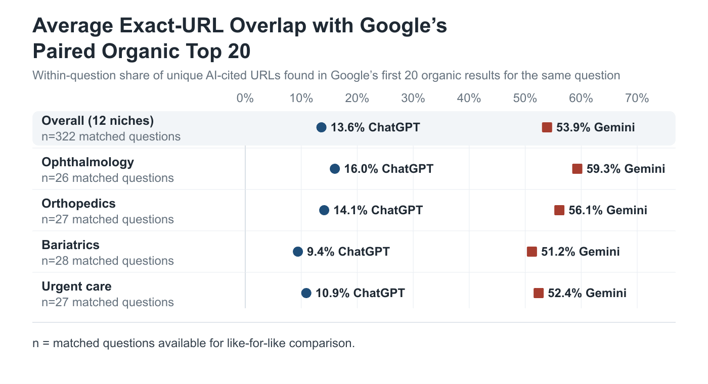
We learned that a patient asking about the cost of cataract surgery, for example, may see one set of pages in Google’s organic results and very different sources cited on ChatGPT and Gemini.
For anyone responsible for marketing at a clinic, hospital, or health system, the takeaway is clear: A specific page from the organization’s website may appear in Google’s organic Top 20, but there’s no guarantee that ChatGPT or Gemini will cite it.
Read on for details of the study, examples of questions, and recommendations for analyzing and improving visibility including a free template to create your own queries.
Why Google Organic Results Are Only a Starting Point
We used Google’s organic Top 20 as the familiar starting point for reporting search visibility for clinics, hospitals, and health systems. Google AI Overviews were not included.
The overlap metric shows the share of each AI system’s unique cited URLs that also appeared in the paired Google organic Top 20.
The question was simple: Do the sources cited by ChatGPT and Gemini also appear among pages in traditional Google organic results? The overlap was only partial. Low overlap means an SEO report alone is not enough and that AI citations must be checked directly.
Overlap Varies by Patient Task
We identified five main patient-task groups which accounted for 321 of the 322 matched questions. The table below shows the question-level average share of ChatGPT and Gemini sources whose exact URLs also appeared in Google’s organic Top 20 for the five categories.

Even for Gemini, a product developed by Google, the overlap remained below 44 percent for questions about eligibility and requirements, process and timing, and finding a local clinic or physician. The overall 53.9 percent figure cited earlier in this article hides this variation. This finding points to the importance of segmenting results by patient task and reporting ChatGPT and Gemini separately.
Sources Diverge Sharply with Questions About Cost
Consider the question, “How much does cataract surgery typically cost in Los Angeles?” Google returned 20 pages in its organic results. ChatGPT and Gemini each cited six sources. None of ChatGPT’s cited sources exactly matched a URL in Google’s organic Top 20; five of Gemini’s six did.
| Platform | Captured Pages and Cited Sources | Exact URL Match With Google’s Organic Top 20 | |
| Google Organic Top 20 | 1. pacificeyemd.com — “Cataract Surgery Cost in California”
2. sidecarhealth.com — “Cost of cataract eye surgery in California” 3. bettervisionguide.com — “Cost of Cataract Surgery” 4. eyecareofsandiego.com — “Cataract Surgery Cost in San Diego” 5. turnereye.com — “How Much Does Cataract Surgery Cost in San Leandro” 6. carecredit.com — “Cataract Surgery: Procedure, Cost and Financing Breakdown” 7. nvisioncenters.com — “Cataract Surgery Cost: Understand Insurance & Added Costs” 8. panhandlevision.com — “How Much Does Cataract Surgery Cost?” 9. la-sight.com — “Cataract Surgery Fees” 10. southwesteye.com — “Cataract Surgery Cost in El Paso and Las Cruces” 11. lucentvision2020.com — “How much does cataract surgery cost in Long Beach?” 12. clearvisioncenter.com — “How Much Does Cataract Surgery Really Cost in 2025?” 13. allaboutvision.com — “Cataract Surgery Cost in 2026: What You Can Expect To Pay” 14. bergfeinfield.com — “Cataract Surgery Cost Los Angeles | Insurance & Financing” 15. envoyhealth.io — “Cataract Surgery: How Much Does It Cost?” 16. ucfhealth.com — “How Much Does Cataract Surgery Cost?” 17. beacheye.com — “Cost of Cataract Surgery” 18. uclahealth.org — “Cataract Surgery & Treatment in Los Angeles” 19. losangelesvisioninstitute.com — “LASIK Cost Los Angeles, CA” 20. oomc.com — “What Does Cataract Surgery Cost?” |
Comparison set | |
| ChatGPT Sources |
|
0 of 6 | |
| Gemini Sources |
|
5 of 6 | |
For priority cost questions such as these, marketers should track the sources cited by each system.
- If an AI system cites a page from your clinic, hospital, or health system, check whether it clearly explains price, insurance, financing, and service availability.
- If the source is an external site, review what it tells patients about your organization.
- If your organization is absent, assess relevant placement opportunities and compare how competitors are represented.
“Low overlap means an SEO report alone is not enough and that AI citations must be checked directly.”
Evgeniy Yudin
ChatGPT and Gemini Cite Different Sets of Sites
In a secondary analysis of 108 questions across ophthalmology, orthopedics, bariatrics, and urgent care, 44 involved finding a local clinic or physician. Average exact-URL overlap with Google’s organic Top 20 was 18.9 percent for ChatGPT and 47.3 percent for Gemini. Cited sites included UCLA Health, Mount Sinai, Northwestern Medicine, Cedars-Sinai, NYU Langone, and Houston Methodist.
For each of those 108 questions, we compared the distinct domains cited by the two AI systems. In 57 questions, ChatGPT and Gemini did not cite a single domain in common; among cost questions, this occurred in 34 of 46 cases.
For clinic- and physician-choice questions, we recommend recording whether the AI system cites:
- A service-line page
- A physician profile, or
- A location page
Check whether it clearly explains what care is available, where it is offered, and which physician or program fits the patient’s need.
More Sources Do Not Guarantee More Overlap With Google
In 72 of 108 questions, ChatGPT cited more unique sources than Gemini. Yet in only five of those 72 questions did ChatGPT also have more exact matches with Google’s organic Top 20. It had fewer matches in 52 questions and the same number in 15.

A longer list could still diverge completely: Among 40 ChatGPT answers with six or more cited sources, 14 had no exact URL match with Google. Source count and Google overlap should therefore be reported as separate measures.
PR teams should identify external sites that ChatGPT and Gemini repeatedly cite and evaluate them as potential outreach or placement opportunities where editorially appropriate. Retest after publication; placement alone does not guarantee citation.
A Practical Plan for Measuring Citation Visibility
A Google organic ranking report does not provide a complete view of AI citation visibility. Measure Google, ChatGPT, and Gemini separately.
- Build prompts. For each priority service line, include questions about cost, choosing a clinic or physician, eligibility, and how to access care. Specify the city, service, and patient task, and freeze the wording.
- Run the same measurement. Use the same wording, location, and settings while minimizing personalization. Manually or through a specialized service, save Google’s organic Top 20 and the sources cited by ChatGPT and Gemini.
- Record site presence. Note whether each AI system cited your organization’s website, which URL it used, and which external sites recur. Segment results by platform, service line, and patient task.
- Test one documented hypothesis. Compare your page with the sources cited by AI: how directly do they answer the question and explain price, insurance, physicians, locations, and access? Make one documented change and rerun the measurement under the same conditions.
Here are some possible outcomes, what they mean, and how to respond:
- If your page appears in Google but neither ChatGPT nor Gemini cites any page from your site, that is a distinct citation-visibility gap.
- If an AI system cites an aggregator, review what that source tells readers about your organization and its competitors.
- If a competitor appears across all three source sets, compare its pages and external profiles with your own.
A Google ranking report does not replace direct monitoring of sources cited by ChatGPT and Gemini. Marketers will need to separately track pages appearing in Google’s organic results, pages cited by ChatGPT, and pages cited by Gemini and other widely used AI platforms.
Method note: On August 7, 2026, the direct comparison included 322 like-for-like U.S.-English medical questions. For each question, we calculated the share of sources cited by each AI system whose exact URLs also appeared in the corresponding Google organic Top 20. Duplicate URLs within an answer were counted once, and every question received equal weight. The 12-niche panel and the 108-question service-line analysis are exploratory. Logged-in consumer app sessions were not included.
Read the full study here: Google and ChatGPT/Gemini Sources Across 12 Medical Niches. Open data: version DOI 10.5281/zenodo.21850734. License: CC BY 4.0.
Build your own repeatable queries with this free Healthcare AI visibility prompt library.
Evgeniy Yudin is the founder of Rotgar and the author of the source-overlap study. He examines how clinics, hospitals, and health systems are represented in Google and AI answer systems. Reach him at evgeniy.yudin@rotgar.com.
