

If You Rank High on Google, Will AI Assistants Cite You? Maybe Not.
Does a strong ranking on the Google search engine results page correlate with high visibility on AI platforms? Results are surprising.
// By Evgeniy Yudin //
 In the not-so-distant past, the coin of the realm in digital marketing was high ranking pages for priority keywords in Google’s Top 20 organic search results.
AI search platforms have introduced a new variable: citations. Today, if your web pages aren’t cited in AI platforms like ChatGPT and Gemini when potential patients are searching for information, you might as well not exist for them.
A recent study conducted by Rotgar looked at 322 medical questions and compared Google’s Top 20 with citations on ChatGPT and Gemini, an AI assistant developed by Google.
For each question, we calculated the percent of unique URLs cited by ChatGPT and Gemini that appeared in Google’s Top 20. Giving every question equal weight, the average overlap was 13.6 percent for ChatGPT and 53.9 percent for Gemini. The chart below also includes similar results for a few sample specialties, with a lower percentage overlap on ChatGPT and a higher percentage on Gemini.
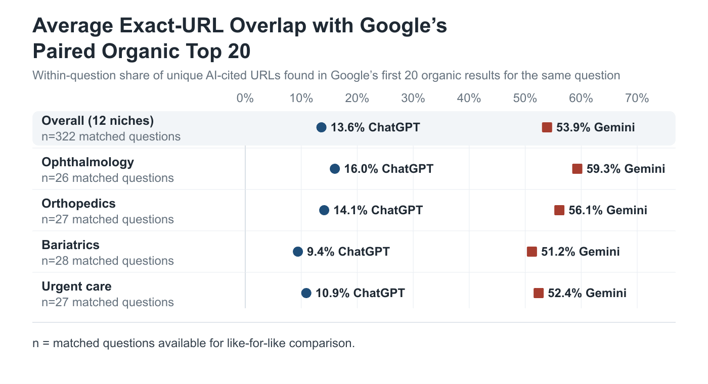
We learned that a patient asking about the cost of cataract surgery, for example, may see one set of pages in Google’s organic results and very different sources cited on ChatGPT and Gemini.
For anyone responsible for marketing at a clinic, hospital, or health system, the takeaway is clear: A specific page from the organization’s website may appear in Google’s organic Top 20, but there’s no guarantee that ChatGPT or Gemini will cite it.
Read on for details of the study, examples of questions, and recommendations for analyzing and improving visibility including a free template to create your own queries.
This content is only available to members.
Please log in.
Not a member yet?
Start a free 7-day trial membership to get instant access.
Log in below to access this content: